Bluon
Bluon
Bluon is the leading provider of technical data and AI-powered support for the HVAC-R industry. The platform provides equipment data, model lookups, manuals, parts cross-references, and AI tech support across 20M+ model numbers from 200+ brands — used by companies like ServiceTitan, BuildOps, Housecall Pro, Goettl, and ARS Rescue Rooter.
I've been at Bluon since June 2023, starting under the SVP of Technology and growing into owning the AI side of the product. Today I'm responsible for MasterMechanic — Bluon's AI-powered technical support tool — from architecture and design through implementation and deployment.
Role: Software Developer (June 2023 – Present) Stack: Next.js, TypeScript, AI SDK, OpenAI, Pinecone, PostgreSQL, Zustand, Zod
MasterMechanic Model Search & Manual RAG Demo
MasterMechanic AI Tools Demo
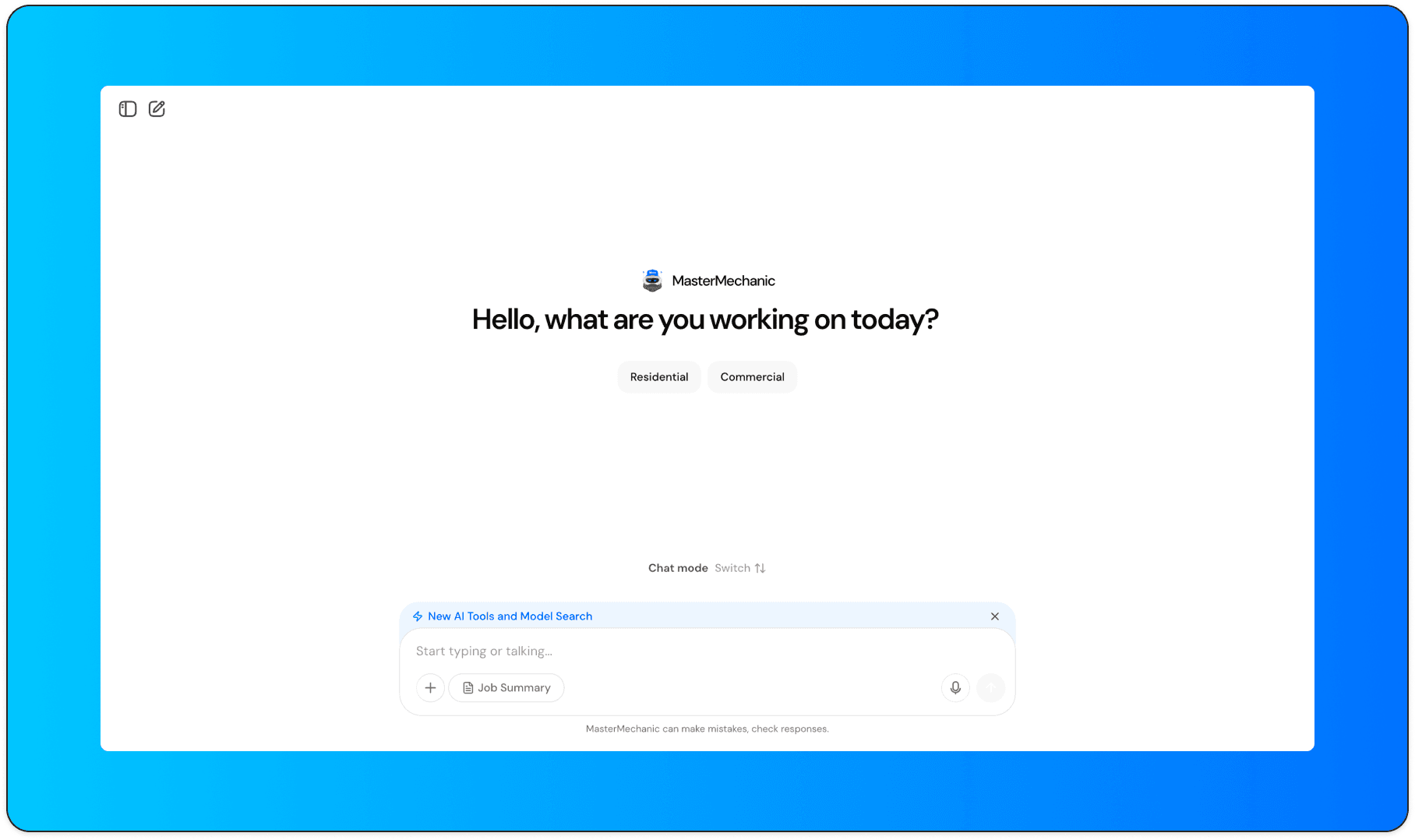
MasterMechanic — AI Tech Support
Techs had no fast way to get expert help in the field
Problem: Bluon ran a 20-person call center to support HVAC technicians on job sites. Techs would call in, wait on hold, and describe their problem to a support rep — while the customer sat in the heat. It was expensive, slow, and couldn't scale. A GPT-3.5 chatbot prototype existed but knew nothing about HVAC — it gave vague answers and hallucinated part numbers. Nobody trusted it.
Solution: Working with the SVP of Technology, I built a RAG pipeline using 50k+ recorded support call transcripts — real conversations full of troubleshooting patterns and field-tested solutions. The pipeline ran OpenAI transcription → LLM filtering → JSON summarization with structured field tags → vectorized and indexed in Pinecone. I also redesigned the chatbot UI and rebuilt it in Next.js with AI SDK.
Result: Retrieval relevance improved from 70% to 92%, validated by a formal evaluation where 20–40 experienced technicians graded responses across 100 standardized questions. Weekly conversations grew from ~100–200 to 2,000+, monthly chats hit 10,000+, and the call center was replaced by AI-assisted self-service.
The AI was hallucinating model-specific details
Problem: The transcript-based RAG worked for general troubleshooting, but techs needed exact answers — specific model specs, compatible replacement parts, error codes. Transcripts couldn't provide that level of precision, and the AI would fill in the gaps with hallucinated data. In HVAC, a wrong part number isn't just unhelpful — it's dangerous.
Solution: Shifted the architecture from pure RAG to AI tool-calling with AI SDK and streaming. Instead of guessing from transcripts, MasterMechanic now calls Bluon's API in real time — model lookup across 20M+ model numbers, nameplate photo reader (I built the first OCR prototype as an intern — it later shipped as a production feature), manual retrieval via Pinecone, and image/file uploads. Each tool is wired with structured schemas and tracked for usage and feedback.
Result: MasterMechanic went from approximate answers to verified, source-backed responses pulled from Bluon's own database. This is what earned technician trust and made adoption take off.
Techs wanted direct access to AI tools, not just chat
Problem: Watching usage patterns, I noticed techs were repeatedly asking the chat to do things it was already doing internally — model lookups, manual searches, nameplate reads. They wanted to go straight to the tool without conversing with the AI first.
Solution: Designed and built an AI Tools dropdown that surfaces all of MasterMechanic's internal tools directly. Techs can now choose to ask the AI or go straight to the tool — whatever's faster for their workflow. This was my idea, from identifying the pattern through prototyping, getting executive buy-in, and shipping through dev → QA → production.
Result: Gave users a faster path to answers and reduced unnecessary chat interactions for straightforward lookups.
Techs kept asking the AI to write up what they did on a job
Problem: A recurring pattern in conversations — techs would finish troubleshooting and then ask MasterMechanic to summarize the job for documentation, their manager, or the customer.
Solution: Built a Job Summary AI feature that auto-generates structured summaries from the conversation history — what was diagnosed, what was done, what parts were involved.
Result: Turned a manual, repetitive task into a one-click feature, saving techs time on every job.
Plugin & API — Partner Integrations
Auth was silently breaking on partner platforms
Problem: Bluon's Plugin and API products embed MasterMechanic and Bluon's tools directly inside partner platforms like ServiceTitan, BuildOps, and Housecall Pro via iFrames. But mobile WebViews and many partner environments silently block third-party cookies — our cookie-based auth was failing for a significant chunk of users with no visible error. Sessions just quietly broke.
Solution: Built JWT-based authentication using the PostMessage API for secure cross-origin token exchange between the parent platform and Bluon's embedded iFrame. Migrated all client-side auth state to Zustand with bearer tokens, completely eliminating the cookie dependency.
Result: Auth works reliably across all partner platforms and mobile WebViews — no more silent failures.
No database existed for chat at scale
Problem: As MasterMechanic usage grew, there was no infrastructure to store conversations, tool calls, feedback, or analytics at scale.
Solution: Designed a PostgreSQL schema from scratch supporting 200k+ chats with relational tables for messages, parts, tool calls, AI responses, shared chats, and user feedback — modeled around AI SDK's UI message format. Built REST APIs and analytics endpoints on top of it.
Result: A scalable data layer that powers MasterMechanic's chat history, analytics, and feedback loops across all deployment contexts.
A breaking SDK change threatened production data
Problem: A breaking change in AI SDK altered how chats and messages were stored, making the existing database format incompatible with the new version.
Solution: Led the production database migration — built type-safe conversion and parsing with Zod to transform all existing chat data to the new format.
Result: Zero data loss. Full migration completed without disrupting live users.
Impact
| Metric | Detail |
|---|---|
| Weekly conversations | ~100–200 at launch → 2,000+ now |
| Monthly chats | 10,000+ |
| Retrieval relevance | 70% → 92%, formally validated |
| Support model | 20-person call center → AI-assisted self-service |
| Data loss | Zero across production migrations |
What I Learned
The hardest part of building AI products isn't the AI — it's figuring out what data to trust. Transcripts got us started, but real accuracy came from connecting to verified source data through tool-calling.
Owning a product means more than writing code. I design prototypes, pitch to C-level executives, push features through dev → QA → production, and catch breaking changes before they hit users. I started at Bluon exploring what AI could do. Now I own MasterMechanic.